A sick pet can’t tell us what hurts. Diagnostics are how we close that gap, and having them in the building means we’re usually not asking you to come back tomorrow.
That speed is the whole point. A result that lands during the appointment changes what we do that afternoon; the same result three days later changes what we do next week, and a lot can happen to a vomiting cat in between.
In-House Laboratory
Complete blood counts, chemistry panels, electrolytes, urinalysis, and cytology are run here, with most results back during your visit. That speed counts most for the vomiting cat, the collapsed dog, and the pre-surgical screen that changes an anesthetic plan.
More specialized testing (culture and sensitivity, histopathology, endocrine panels) goes to a reference laboratory, usually back within a few days.
Bloodwork Before Anesthesia
Every patient going under anesthesia gets bloodwork first, and it isn’t a formality. A liver or kidney value that’s off changes which drugs we use and at what dose, because that’s how the drugs leave the body. Anemia changes how much oxygen the blood can carry. We have cancelled and rescheduled procedures on the strength of a pre-anesthetic panel, and those are good days, not bad ones.
Senior Screening
In an older animal, bloodwork and urine done once a year do something an exam can’t: they show a trend. Kidney disease, hyperthyroidism in cats, Cushing’s and diabetes in dogs all declare themselves in numbers long before the animal looks unwell, and all of them are far easier to manage caught early. A single result tells us whether a value is in range. Three years of results tell us which direction an animal is travelling, which is the more useful thing to know. See senior care for what that schedule looks like.
Digital X-ray
Our X-rays are digital, viewable immediately and easy to share with a specialist when a case calls for a second opinion. We use them for chest and abdominal work, orthopedics, foreign bodies, and full-mouth dental imaging.
Most pets are radiographed awake, with gentle positioning and someone they can see. Sedation comes up when an animal is painful, when the position needed is one a sore hip won’t allow, or when holding still would frighten them more than a short sedation would — we’ll talk it through rather than wrestle.
Ultrasound
Ultrasound shows us soft tissue and movement that X-rays can’t: the internal structure of the liver, kidneys, spleen, and bladder, fluid where there shouldn’t be any, and pregnancies. It’s non-invasive and usually needs no sedation.
It’s also how we take samples safely. A needle guided by ultrasound can reach a mass, a bladder, or a pocket of fluid without exploratory surgery, and in many cases that single sample is what turns a list of possibilities into a diagnosis.
Fur has to come off a small patch for the probe to make contact, which surprises people — it grows back.
What Happens With the Results
We go through them with you in plain language, in the room where possible, and you get a copy. If something needs a specialist — a cardiologist, an internist, an oncologist — we refer, and the images and records go with you so nothing is repeated at your expense.
CT
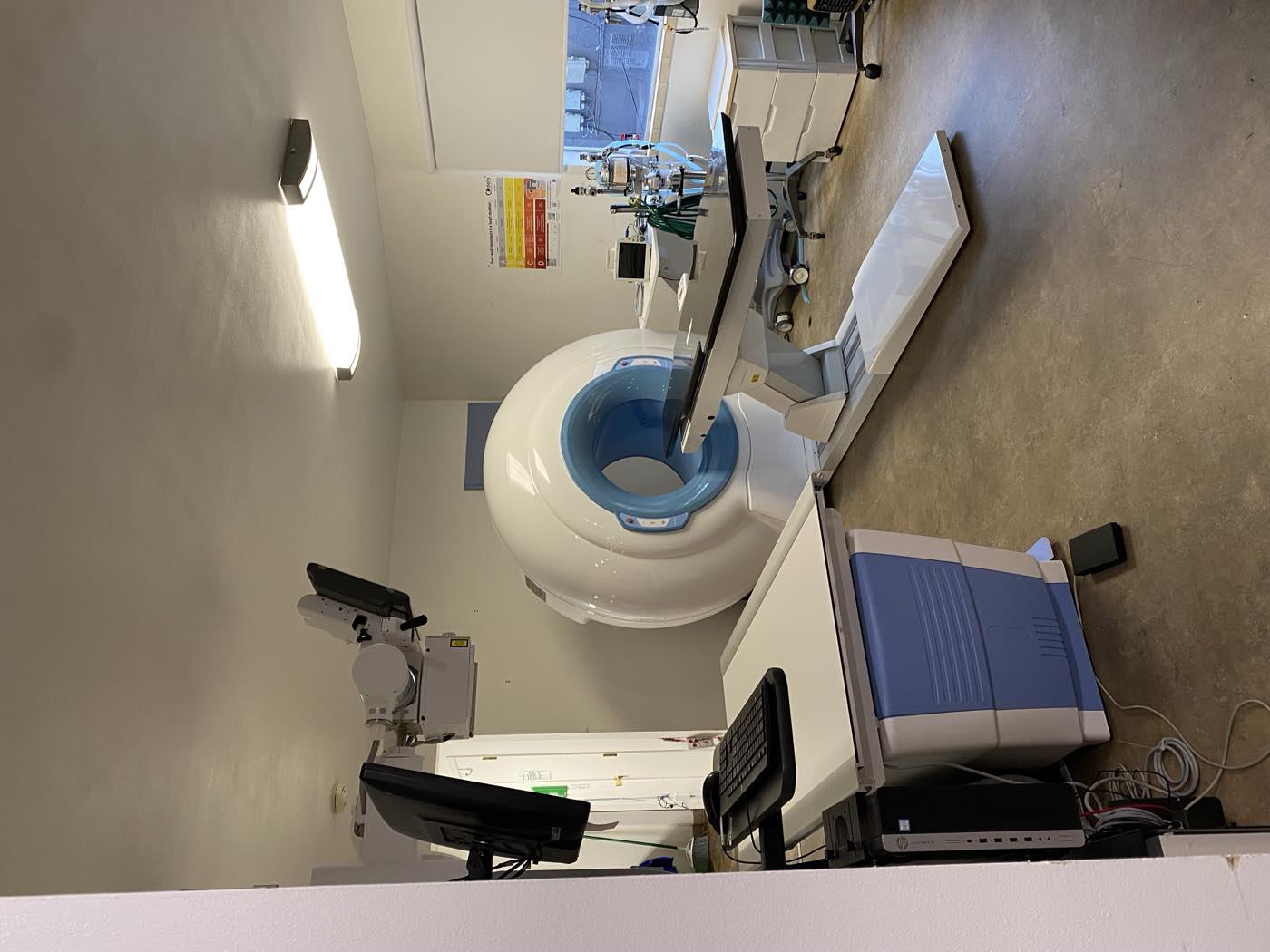
We also have CT on site, for the cases where X-ray and ultrasound can’t give us the whole picture.